 I've got a new addition to my library and this one will definitely end up on the coffee table... Core Memory: A Visual Survey of Vintage Computers is a mostly photographic account of a small number of historic computer systems ranging from the 1950's to the present. These images were taken of systems provided by our friends over at the Computer History Museum in California. This is a somewhat artistic view of early technology which many will find strange and intriguing. It is hardcover bound and is nicely printed on photographic quality paper. Definitely a fun voyage through time for the interested!
Showing posts with label Books. Show all posts
Showing posts with label Books. Show all posts
Sunday, February 10, 2008
Core Memory: A Visual Survey of Vintage Computers
I've got a new addition to my library and this one will definitely end up on the coffee table... Core Memory: A Visual Survey of Vintage Computers is a mostly photographic account of a small number of historic computer systems ranging from the 1950's to the present. These images were taken of systems provided by our friends over at the Computer History Museum in California. This is a somewhat artistic view of early technology which many will find strange and intriguing. It is hardcover bound and is nicely printed on photographic quality paper. Definitely a fun voyage through time for the interested!

Thursday, November 9, 2006
Book Review: iWoz
 It seems his whole life was leading up to that moment... he spent his teenage years designing and re-designing time-sharing mini computers in his mind and on paper. He taught himself how to build a video display terminal by studying surplus video equipment. He constantly demonstrated his intellectual prowess by designing and re-designing hobby electronic projects to use fewer and fewer parts. But when this quiet engineer sat in the back of the room at an early Homebrew Computer Club meeting and heard of this new chip, called the 6502, it all came together.
 His invention, a combination of a microprocessor, keyboard interface, and video display circuitry all on one board took the club, and eventually the world by storm. While Woz is no Shakespeare, his book does give a fascinating glimpse into the mind of a brilliant, and somewhat unknown other Steve, Steve Wozniak, the inventor of the Apple I and Apple II computers. It also makes one realize that while he developed the Apple II almost entirely on his own, he needed the opposite personality traits of Steve Jobs to complement his work and that combination is what really led to the winning team they built 30 years ago.
Tuesday, September 26, 2006
Book Review: ON THE EDGE The Spectacular Rise and Fall of Commodore
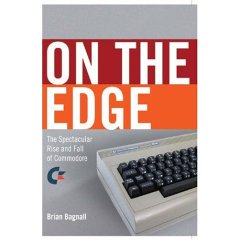 ON THE EDGE The Spectacular Rise and Fall of Commodore is a must have for any retro-enthusiast's library. This book has become the definitive reference for Commodore 64 lovers seemingly overnight. The author, Brian Bagnall, has done a tremendous amount of research and collected many first hand interviews of the key developers and company officials from the eighties and nineties.
While numerous titles over the years have been dedicated to the early history of Apple Computer, Commodore has somehow missed out on the limelight. And this, despite the fact the the C64 remains the most popular personal computer model of all time in terms of total units sold.
The heart of the book is the many first hand accounts of the ups and down of the tumultuous C64 era, and the company's inability to successfully move its huge install base to a next generation Commodore product. There is even some new and interesting accounts of early encounters with Bill Gates licensing BASIC for the PET. Reading this 500+ page book was immensely enjoyable and informative.
While the post-C64 section focusing on the Amiga years was a little light on substance, I found the first section of the book most informative and enjoyable. This section starts by introducing the reader to the legendary Chuck Peddle, the creator of the 6502 processor which was the basis of many of the early personal computers (Apple 1, Apple II, Atari 400/800, Atari 2600 game console, Commodore PET, VIC-20, Commodore 64, KIM-1, SYM-1, Rockwell AIM 65, and many others).
Peddle's company, MOS Technology, was subsequently purchased by Commodore and became the genesis for most of the computers commodore produced in the early years. In fact, if I took away one thing from reading this book, it was a new found appreciation of just how influential a figure Chuck Peddle was to the birth of the computer revolution. This is a must read for all fans of 8bits!
Friday, January 20, 2006
Soul Of A New (Old) Machine
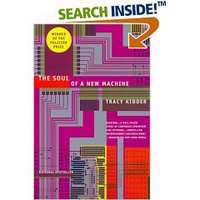
In 1980, Data General was a fast growing minicomputer manufacturing company poised to take over DEC and possibly IBM with their next generation of Eclipse computers. In 1981, Tracy Kidder released The Soul of a New Machine, a compelling best-selling story of the people and personalities involved in creating that new machine. Today the company no longer exists, but this book is still as good a read as it was 25 years ago.
I first read this in 1981, and it had a profound impact on my career. In fact, it was one of the catalysts that caused me to go into the same industry (I worked for IBM designing systems in the mid 80's). In 2000, Wired Magazine did a profile on Tom West, the improbable hero of the story, and discussed where his career took him after this book, as well as how his perception of those times has changed.
If after reading these you want to explore further, try running the simh emulator and log on to your own Eclipse system and explore their handiwork!
Tuesday, February 15, 2005
DIGITAL RETRO
Looking for something to put on your coffee table that really captures the essence of that vintage computer collection of yours? How about a beautiful book on photo grade stock with pictures of all your favorite personal computers from the seventies and eighties and more? Check out this book by Gordon Land called DIGITAL RETRO the evolution and design of the personal computer. All of my favorites are in here; Apple I, Apple II, Sinclair ZX81, Atari 800, IBM PC, IBM PCAT, Macintosh and over 40 others. Great photos and short historical descriptions accompany each making this an interesting read from end to end, or just fun to browse.
 An Amazon.com reviewer writes of this book "Take a visual stroll through the early days of personal computing, from 1975's seminal MITS Altair to 1988's failed NeXT cube, before the market bifurcated between Mac and Windows users. This 192-page paperback examines 40 classic computers of yesteryear, each depicted from all sides with full-color photography and annotated with original specifications and pricing. Laing's text also reveals many juicy tidbits about the companies and personalities that dominated the industry in its infancy."
An Amazon.com reviewer writes of this book "Take a visual stroll through the early days of personal computing, from 1975's seminal MITS Altair to 1988's failed NeXT cube, before the market bifurcated between Mac and Windows users. This 192-page paperback examines 40 classic computers of yesteryear, each depicted from all sides with full-color photography and annotated with original specifications and pricing. Laing's text also reveals many juicy tidbits about the companies and personalities that dominated the industry in its infancy."
Subscribe to:
Posts (Atom)